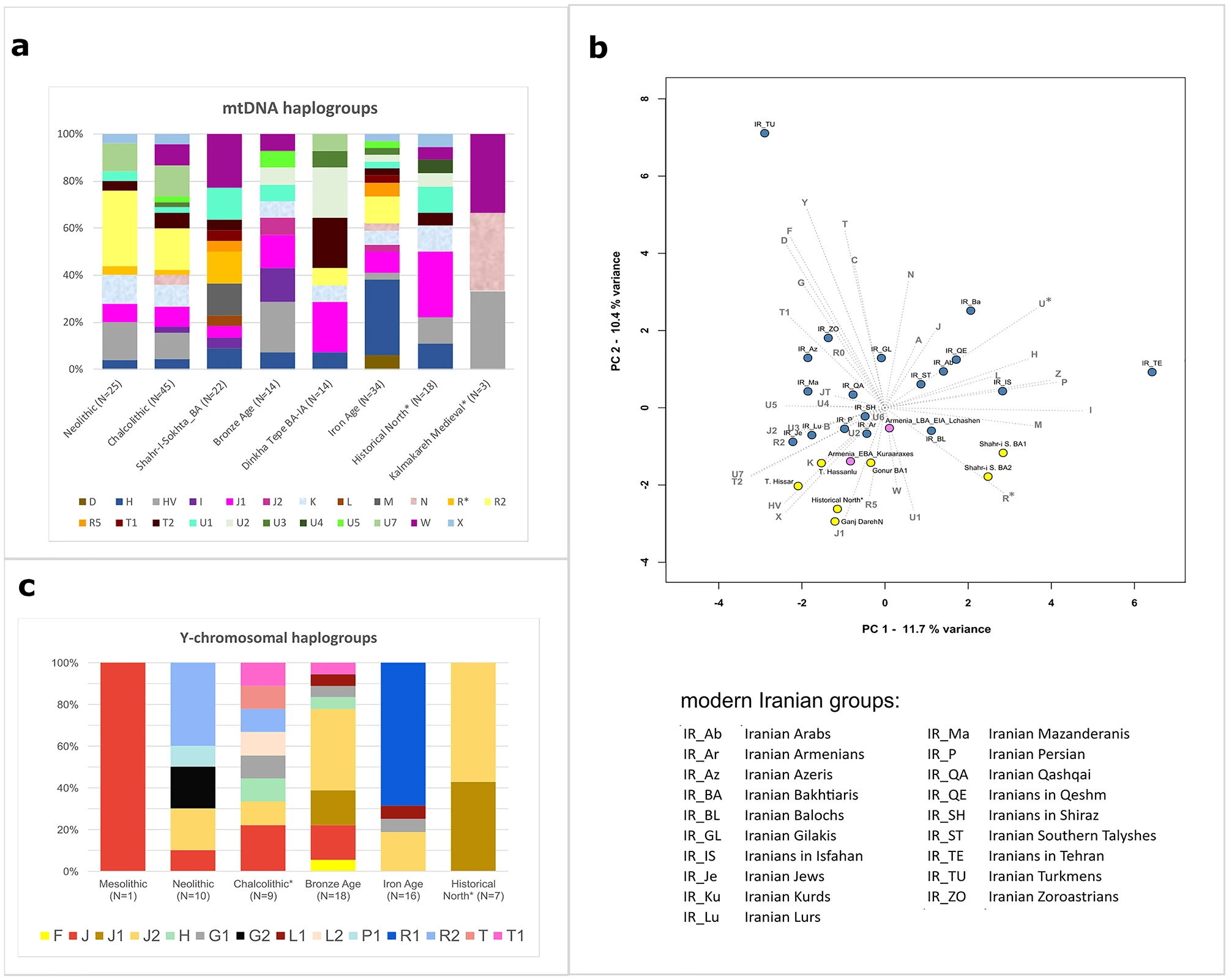
Sage Angiras was one of the earliest Vedic sage and the manasputra of Lord Brahma. He was regarded as the originator of Angi the fire god and also who has a day-to-day empirical view of Para-Brahma. He is called, besides, the priest of the Gods, the Lord of the sacrifice & agni. Sometimes he is considered as a son of Uru by Āgneyī, the daughter of Agni. Uru probably meant Ur the huge Chalcolithic city part of Sumeria that had vast trade networks including India. There were local trading posts in India on Indus and in Gujarat that recruiting locals in India well versed with fire and food and ayurvedic medicine and astronomy etc.. Sage Angirasa probably from that era and looking at the other nearby Indus periphery cities of Shahr-e-Sokhte and Gonur we can find Indian H-M82 samples along with J2a and J1 in a highly mixed forms. This group might have been the one managing the original trading posts and the foreign merchants who were wealthy and many times sources of income. In later Vedic literature the traders are called Panis viewed as a competition but the earlier hymns in Rig Veda they were called as Asuras and were revered. Even the Gods Varuna and Indra were some times revered as beneficial Asuras. We have archealogical evdences of fire pits in Saraswati river basin even earlier and in Mehrgarh towards Iran.
In Hymn XVII from the Rigveda Book, of Griffith, we see people praying for Varuna and Indra for blessings and work
14 With bending down, oblations, sacrifices, O Varuna, we deprecate thine anger:
Wise Asura, thou King of wide dominion, loosen the bonds of sins by us committed.
Hymn 151
15 Loosen the bonds, O Varuna, that hold me, loosen the bonds above, between, and under.
So in thy holy law may we made sinless belong to Aditi, O thou Aditya.
3 The folk have glorified your birth from Earth and Heaven, to be extolled, ye Strong Ones, for your mighty power.
Ye, when ye bring to singer and the rite, enjoy the sacrifice periormed with holy praise and strength.
4 The people prospers, Asuras! whom ye dearly love: ye, Righteous Ones, proclaim aloud the Holy Law.
That efficacious power that comes from lofty heaven, ye bind unto the work, as to the pole an ox.
5 On this great earth ye send your treasure down with might: unstained by dust, the crowding kine are in the stalls.
Here in the neighbourhood they cry unto the Sun at morning and at evening, like swift birds of prey.

The Matsya Purāṇa says that Aṅgiras was one of the three sages produced from the sacrifice of Varuṇa and that he was adopted by Agni as his son and acted for some time as his regent. He was intimately connected with sacrifices to Agni and practical sciences such as Ayurveda, Astrology and who mastered Agni or the fire for day-to-day purposes. These skills were very useful during the Chalcolithic and Early Bronze age when the traders look for stable posts nearby to carryout seasonal trade. Angiras was probably such early sage character from the early Saraswati Sindhu Culture who excelled in maintaining these early traders and leading the settlement. We have evidence of priests from IVC through archeological records.

We have historical evidence of a huge number of sacrificial fire pits in the Indian valley Civilization. Sage Angiras was probably the personification of elders of the previous Saraswati Sindhu Civilization who have mastered fire and can make sacrifices to appease God's and Kings and Important people etc... Angiras is claimed by both Brahmin and Kshatriya castes since we have descendants. Atarvana veda has numerous hymns for Agni and how we can appease Lord Indra to serve the purposes of the society. Also it has hymns to revoke characters who have money but are not beneficial for the society. There are numerous invocations for River Sarasvati to benefit the society and to provide a purpose for the sages doing sacrifices for the progress of the society. These concepts have carried on the great Sarasvati Sindhu traditions later into every day Hindu lives.
In AV VII 115
1. Fly forth from here, O evil sign (lakṣmī́) pāparūpiṇy alakṣmi;; disappear from here; fly forth from yonder; with a hook of metal (ayasmáya) we attach thee to him that hates [us].2. The unenjoyable flying sign that hath mounted me, as a creeper a tree—that, O Savitar, mayest thou put hence elsewhere than on us, being golden-handed, granting good to us.
3. A hundred and one [are] the signs of a mortal, born from his birth together with his body; the worst of these we send forth out from here; to us, O Jātavedas, confirm propitious ones.
4. These same have I separated, like kine scattered on a barren (khilá); let the good (púṇya) signs stay; those that are evil have I made disappear.
Angiras Rishi is a luminary in the realm of Vedic hymns. His contribution to the Rigveda shines brightly, with hymns attributed to him and his student family, the Angirasas, spanning multiple Mandalas – specifically the first, second, fifth, eighth, ninth, and tenth books. Several Angirasa sub-clans, such as the Śunahotras, the Gautamas, and the Bhāradvājas, also made significant contributions, composing Mandalas II, IV, and VI respectively . The very fact that sage Angiras mastered the fire and considered the master of Para-Brahma and who can reject rich trading people for the purpose of the society shows he was probably from the previous EBA era of the Mesopotamian trade. Where he was initially born as mind born son of Trading God Varuna for his deeds with Agni/fire and his mastery of Ayurveda and practical Astronomy and herbs etc.. his influence on the later Sages and attraction of the incoming MLBA steppe people in 1450 BC was his greatest achievement. He is considered the father of Sage Bharadwaja but it was probably a mind born son from the later Iranian groups who settled among Kshatriyas and fighting Brahmins. Many newer castes like Vaidyas have started from earliest traditions of the Angiras.
Mahabharata describing Angiras
Mbh.3.83.4357 It was here that Angiras, that ocean of ascetic austerities belonging to the Saraswata race, was born, Bathing in that tirtha, one obtaineth the merit of the horse-sacrifice, and without doubt, gaineth also residence in the legion of Saraswati